

High-numerical-aperture (NA=0.55) extreme-ultraviolet (EUV) lithography is revolutionizing chip fabrication. Intel deployed the first high-NA EUV scanner in 2024, enabling finer patterns and extending Moore’s Law. These tools double the resolution of existing EUV systems, supporting sub-2nm pitch devices and reducing cost per transistor.
Key Impact: High-NA EUV enhances precision for complex patterns, sustaining scaling into the late 2020s. Intel and TSMC plan production use by 2025, enabling logic nodes like 1nm and 0.5nm.
New transistor designs are overcoming the limits of planar scaling:
Gate-All-Around (GAA) Nanosheet FETs: Now in production at ~2nm, GAAFETs wrap gates around ultrathin silicon channels, improving control and enabling vertical stacking for higher current. They are the successors to FinFETs, extending the scaling roadmap.
Complementary FETs (CFETs): In R&D, CFETs stack nFETs and pFETs vertically, offering 30–50% logic density gains. They target future nodes (~A7–A10).
Vertical-Transport FETs (VTFETs): IBM and Samsung’s VTFETs route current vertically, potentially doubling speed or cutting energy by 85% compared to FinFETs. These remain in early research.
Key Impact: These architectures enhance density and efficiency, pushing performance beyond traditional FinFET limits.
Chiplets and advanced packaging are replacing monolithic dies. Modular blocks (CPU, GPU, memory) are integrated using technologies like Intel’s EMIB and Foveros or AMD’s Infinity Fabric. This approach optimizes each block’s process node, improving yield and cost. Standards like UCIe enable interoperable chiplet ecosystems.
Chiplet Designs: By 2025, servers will widely use chiplets for CPUs, GPUs, and AI accelerators.
3D Stacking: Hybrid bonding and through-silicon vias (TSVs) achieve sub-10μm bump pitches, boosting interconnect density by over 10×. Intel’s Foveros Direct exemplifies this trend.
Key Impact: Heterogeneous integration delivers scalable, cost-effective systems with high bandwidth and low latency.
Silicon photonics integrates optical I/O into chips, using light to move data with higher bandwidth and lower power than copper. By 2025, photonics will become mainstream, with solutions like Ayar Labs’ 8 Tb/s UCIe-compatible optical chiplet and LightMatter’s 256 Tb/s interconnect.
Co-Packaged Optics (CPO): Broadcom and Nvidia are integrating optics into switch packages, improving bandwidth-per-watt by orders of magnitude.
Applications: Photonics will power AI, HPC, and quantum networks, offering ultrafast, energy-efficient links.
Key Impact: Optical interconnects break electrical I/O bottlenecks, critical for AI and exascale computing.
Specialized accelerators like GPUs, TPUs, and ASICs are outpacing general-purpose CPUs for AI, graphics, and crypto workloads. These domain-specific architectures (DSAs) deliver massive performance gains:
Neuromorphic Chips: Intel’s Loihi 2 and IBM’s TrueNorth mimic brain-like processing, achieving up to 1000× energy efficiency for AI inference.
Hybrid Superchips: AMD’s Instinct MI300 and NVIDIA’s Grace Hopper combine CPU, GPU, and HBM dies for versatile HPC/AI performance.
Reconfigurable Logic: FPGAs and custom IP blocks offer post-silicon flexibility.
Key Impact: DSAs enable task-specific speedups, redefining performance through architectural innovation.
New materials are enhancing chip performance:
2D Semiconductors: Atomically thin materials like molybdenum disulfide (MoS₂) enable low-leakage, ultra-scaled transistors for future FETs.
Wide-Bandgap Materials: Gallium nitride (GaN) and gallium oxide (Ga₂O₃) improve power and RF chips, with Intel integrating GaN with CMOS for efficient power delivery.
Advanced Dielectrics: Cobalt/ruthenium interconnects and tunable low-k dielectrics from startups like Thintronics reduce signal loss, potentially eliminating interposers.
Key Impact: These materials reduce heat, latency, and power, enabling denser, more efficient chips.
Emerging paradigms are redefining computation:
Neuromorphic Processors: Brain-inspired chips like Loihi 2 use event-driven circuits for ultra-efficient AI tasks, ideal for always-on sensors and robotics.
Quantum Computing: IBM, Google, and PsiQuantum are advancing qubit counts, with photonic qubits offering scalability and error correction. While not yet mainstream, pilot quantum cloud services are emerging.
Key Impact: These technologies promise exponential gains for specialized tasks, bypassing traditional scaling limits.
AI is transforming chip design and verification. Tools like Synopsys’ DSO.ai reduce optimization cycles from months to weeks, cutting time-to-market by 75%. AI optimizes layouts, detects defects, and predicts tool failures:
Smart Placement/Routing: Reinforcement learning improves chip layouts and timing.
AI Verification: Machine vision boosts yields (e.g., TSMC’s 20% 3nm yield improvement via AI defect detection).
Generative Design: AI agents propose and validate floorplans, accelerating design cycles.
Key Impact: AI-driven EDA multiplies engineering efficiency, sustaining Moore’s Law through smarter workflows.
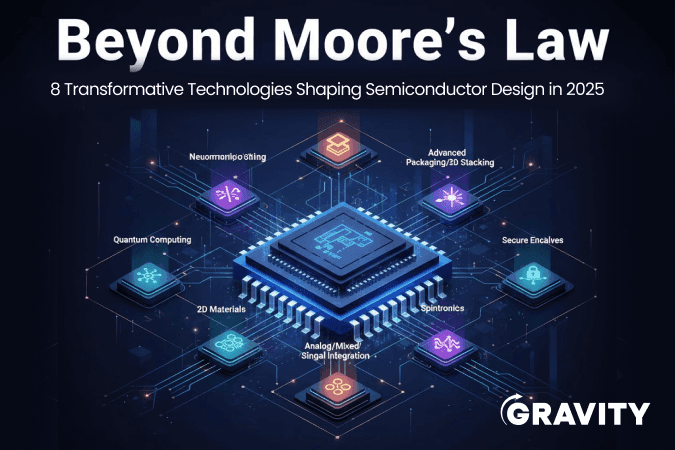
In 2025, Moore’s Law evolves beyond transistor scaling into a multidimensional strategy. Advanced lithography, novel transistors, chiplet packaging, photonics, specialized accelerators, new materials, emerging computing paradigms, and AI-driven design are collectively driving performance gains. Engineers mastering these technologies will shape the future of computing, delivering chips that power AI, HPC, and beyond.